
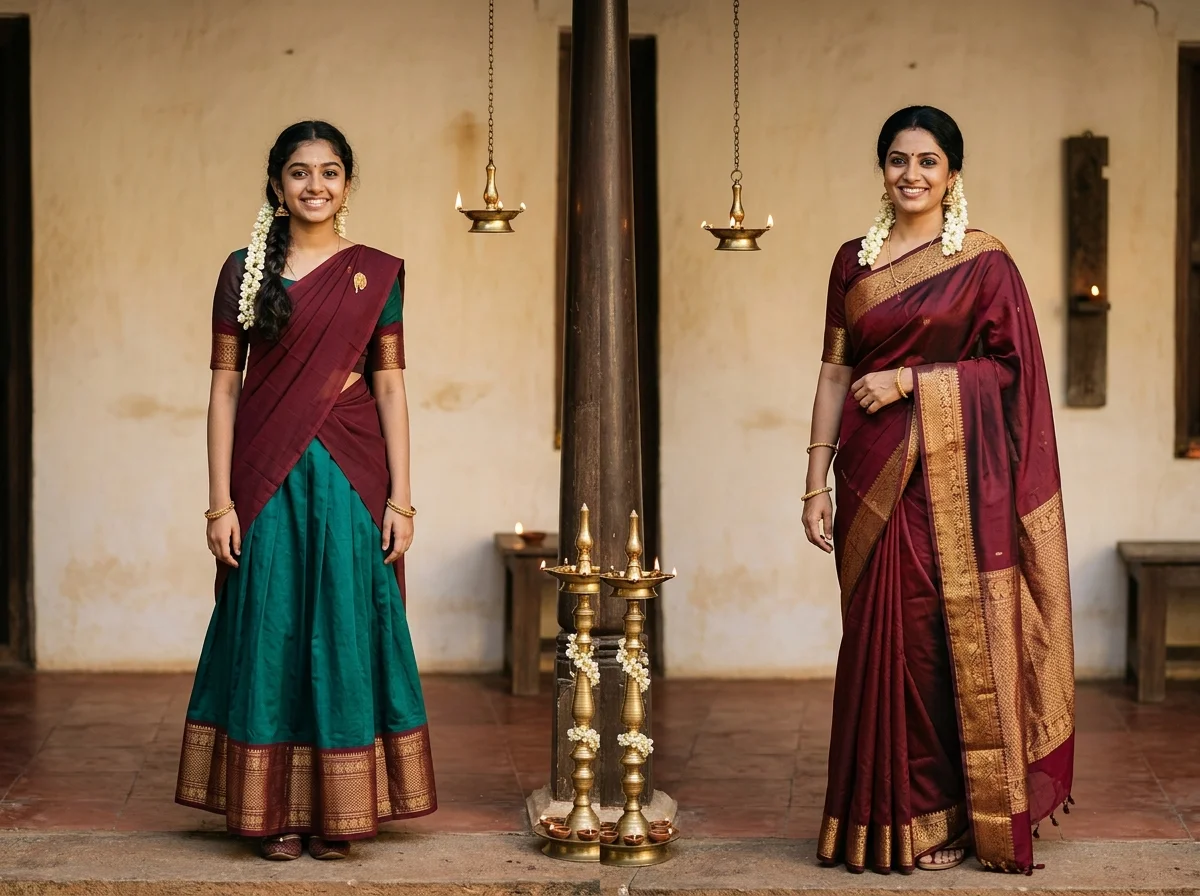
If you are deciding between a dhavani and a saree, here is the short answer. A dhavani (half saree) is a three-piece outfit: a long skirt, a fitted blouse and a half-length drape. It is traditionally worn by girls and young women, and it is quicker to put on and easier to move in. A saree is a single length of fabric of around five and a half to six yards, worn over a blouse and petticoat, and it is the default for married women and for formal occasions. Both work for most South Indian festivals. The right choice depends on the occasion, your age and comfort, and how long you will be on your feet.
What each outfit is made of
Dhavani
- Pavadai (skirt): long and flared, often with a contrast zari or woven border.
- Blouse: fitted and cropped, usually matching the border.
- Dhavani (the drape): tucked at one hip, pleated across the front and pinned at the left shoulder.
Saree
- The saree: one continuous length, tucked and pleated at the front with the pallu over the shoulder.
- Blouse: fitted, and either bought stitched or tailored from a blouse piece.
- Petticoat (underskirt): a drawstring skirt that holds the tucks. A dhavani does not need one, because the pavadai does that job.
Who traditionally wears which
Customs in Kerala, Tamil Nadu, Karnataka and Andhra Pradesh follow a rough path. Little girls wear a pattupavada (skirt and blouse only). As teenagers they move on to the dhavani, which adds the drape. The saree comes later, in some families for a coming-of-age ceremony and in others for college or marriage. Families abroad are much more relaxed about this: plenty of women in their twenties and thirties wear a dhavani for Onam simply because they like it, and teenagers borrow their mother's kasavu saree. Nobody at a Melbourne, Dublin or London Onam celebration is checking.
Occasion guide
Onam
Both are correct. The classic Kerala look is white-and-gold kasavu, either as a kasavu saree or set mundu for women or as a kasavu dhavani for younger wearers. If you are serving at a sadya or dancing thiruvathira, a dhavani stays put better and there is no pallu to trail through the payasam.
Temple visits and pujas
A cotton saree or a Kanji cotton dhavani both work. Choose cotton over silk if you will be sitting on the floor for a long time.
Weddings
Guests who are close family usually wear silk or Banarasi sarees. Younger cousins and bridesmaids often coordinate in matching dhavanis, which photographs beautifully as a group.
Dance performances and arangetrams
For the audience and family, a dhavani is the popular choice. A pre-stitched dawani is the safest option if you will be moving a lot.
Office Diwali or a multicultural work event
A ready-to-wear saree or a light mulcotton saree is easy to manage for a day at work and comfortable at a desk.
Practical differences
- Time to dress: a dhavani takes around ten minutes, while a first saree drape can take half an hour and a second pair of hands. Ready-to-wear and stitched versions of both close that gap.
- Sizing: a dhavani comes sized (S to 3XL at Veuxo). A saree itself is one size, and only the blouse is sized.
- Weather: for Onam during an Australian late winter or a damp Irish September, cotton layers well under a cardigan. Silk pallus crease less when you are wearing a coat over them.
- Price: at Veuxo, dhavani sets cost £42.99–£49.99. Kerala cotton sarees start at £26.99.
How to choose in one minute
- Is it your first time draping anything? Choose a stitched dawani or a ready-to-wear saree.
- Will you be on your feet, serving or dancing? Choose a dhavani.
- Is it a formal wedding or reception, and are you a close relative? Choose a silk saree.
- Is it Onam and you want the classic look? Choose kasavu, in either style.
Shop the looks
Browse dhavani sets, sarees and, for girls, pattupavada.
Not sure about size? Every product page has its own chart, and you can request a size exchange within 7 days of delivery if the item is unworn with its tags attached. You pay the return postage.